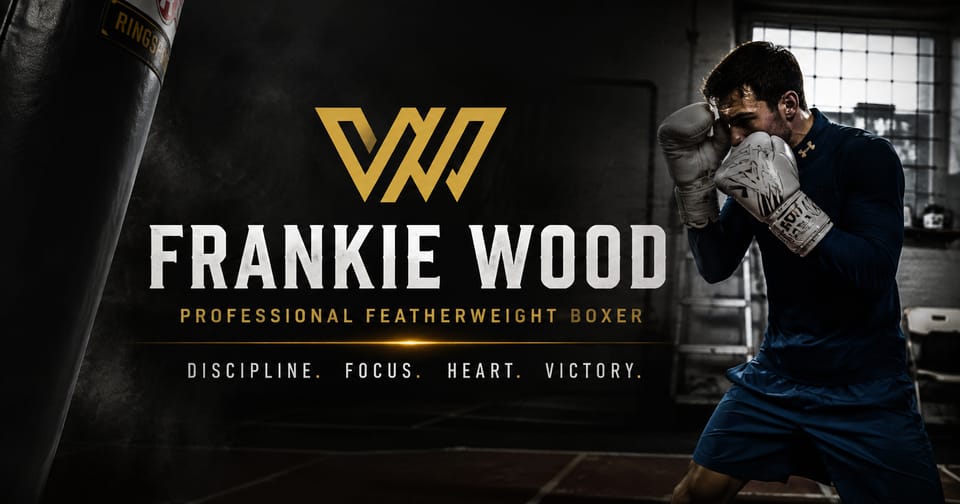
Before Frankie Wood threw a single professional punch, he had already done more than most fighters accomplish in a full career. Six national amateur titles. Fifteen international bouts representing England. Competing on the world stage against Team USA at the World Championships. When he signed with Frank Warren’s Queensberry Promotions and turned professional, the credentials were not in question. What he needed was a digital home that matched the level.
Frankie came to us with a 4–0 professional record, a growing following on Instagram, and interviews already landing on iFL TV and International Boxing News. The material was there. The task was to turn it into a platform that could grow with him — something that a new fan could land on and immediately understand who he is and what he is building, and that would be ready the moment fight number five is announced.
The brief
A professional boxer’s website has two modes: waiting and announced. For most of the year, the site is building the audience — telling the story, showing the record, embedding the media coverage, growing the mailing list. When a fight drops, everything shifts: the next fight page becomes the most important real estate on the site, and every visitor should be one click from a ticket link or a mailing list signup.
The site had to handle both modes cleanly. It also had to look like it belonged in professional boxing. A generic light-theme template would have been wrong for the brand; Frankie’s world is dark arenas, ring lights, and championship gold, and the site needed to reflect that.
What we built
A dark, high-contrast design built for the sport
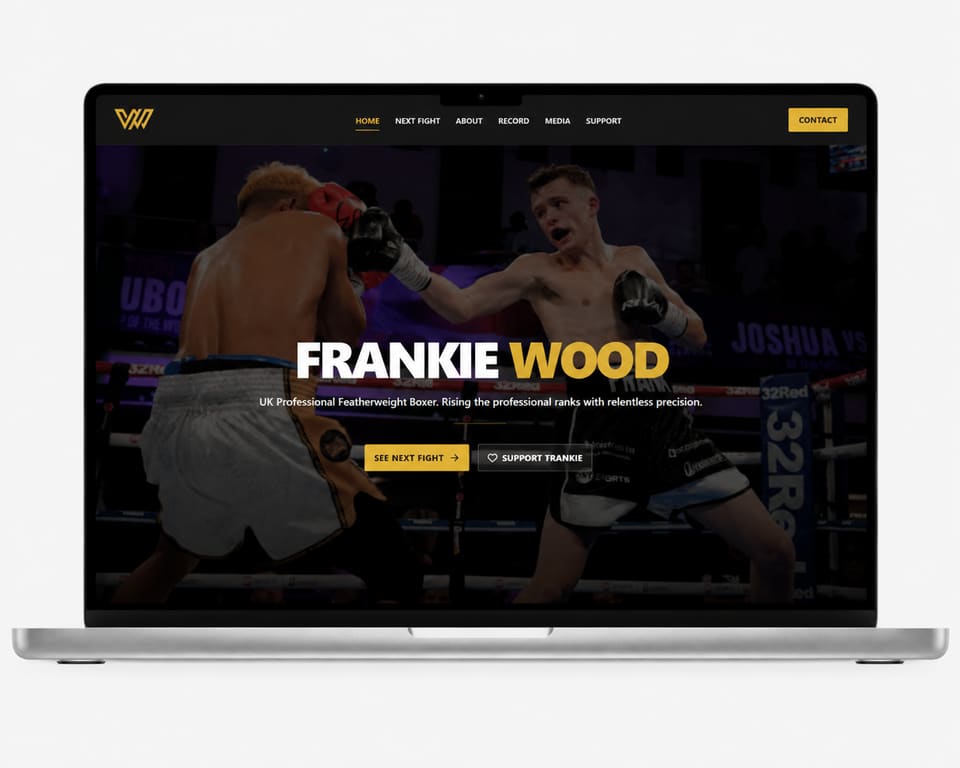
The site runs on a near-black background with a championship gold accent — a palette pulled directly from the Wood Boxing brand identity. The monogram logo, a bold W in gold, sits in the header and reads clearly at any size. Hero images from weigh-ins, ring walks, and fights cycle through a full-bleed carousel above the fold, so within seconds of arriving a visitor knows this is a serious fighter with real fight night photography behind him.
Typography is set for legibility at pace. People visiting a boxer’s website are not slowly reading articles; they are scanning for the next fight date, the record, the highlights. The hierarchy of the site reflects that.
Career highlights front and centre
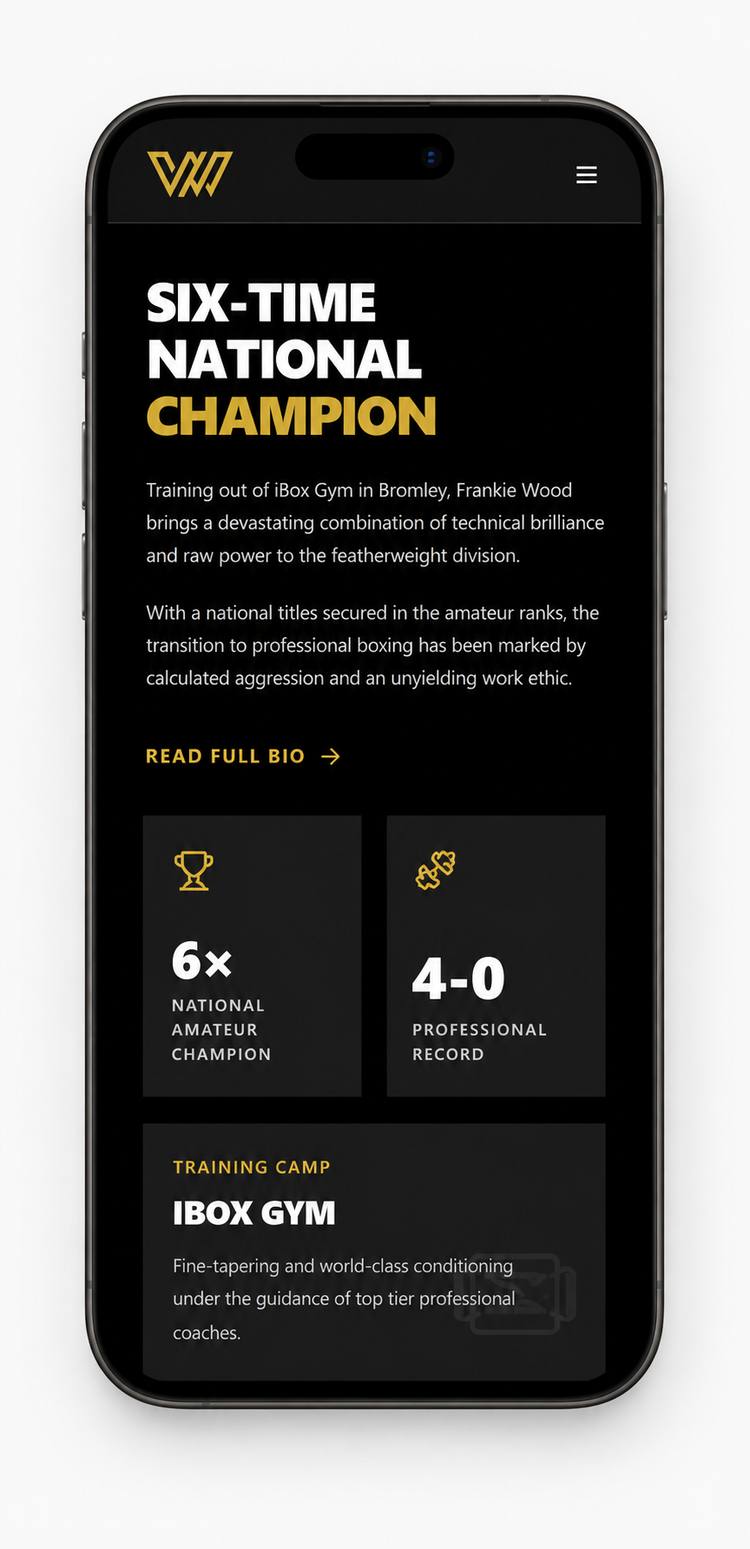
The statistics that define Frankie’s career — 4–0, 1 KO, 15 international bouts for England, 6× national amateur champion — are surfaced in a stats bar directly below the hero. This is the information that contextualises everything else. A visitor who has not heard of Frankie Wood knows within ten seconds that they are looking at a fighter with a proper amateur pedigree who is building an unbeaten professional record.
This section deliberately does not bury the amateur record. In boxing, amateur credentials matter. A six-time national champion who represented England for 15 consecutive international fights and competed at the World Championships is not a background-fill detail; it is the foundation of the story.
A fight record that earns trust
The professional record page gives the full picture: result, method, opponent, and a written summary of each bout. As Frankie builds his record fight by fight, this page builds with him.
The record is honest about where bouts are TBC. No filler, no padding — the entries reflect exactly what has happened, in the right format, ready to be updated the moment new information is confirmed. When details come through, it takes a single edit to go from TBC to a full fight breakdown.
The next fight page: designed for announcement
The next fight page has two states. When there is no fight booked, it holds the mailing list call to action: an honest note that there is nothing to announce yet, but that the way to be first to know is to sign up. When a fight is announced, the page becomes fight central — date, venue, opponent, and ticket link front and centre.
That mailing list is the key retention mechanism. Boxing audiences are not visiting a fighter’s website every week unprompted. The value of the site is capturing interest at the moment it exists — after a fight, after a viral clip, after a TV interview — and converting that into a direct line that survives until the next announcement. Every new visitor who subscribes is one less person who relies on the algorithm to see the fight card.
Media: interviews and gallery in one place
The media page pulls together the YouTube coverage that already exists — the iFL TV interview, the International Boxing News pieces — and displays it alongside the fight and training gallery. A visitor who arrived cold can spend ten minutes on this page and come away with a complete picture: the style, the personality, the trajectory.
The gallery is categorised by type — fight action, weigh-ins, training, victory — so press, promoters, or fans can find the specific imagery they are looking for without paging through everything at once.
Support page for fans who want to back him
Boxing at this level is not fully self-funding. Frankie trains full-time at iBox Gym in Bromley and, like every fighter coming up through the pro ranks, benefits from a fanbase that is actively behind him. The support page makes it easy for fans who want to contribute to find the right way to do it — whether that is following on Instagram, joining the mailing list, or going further.
This is a page that matters more than it looks. It is not transactional; it is relational. It tells fans that the fighter sees them, appreciates the support, and gives them a role in the journey.
Technical delivery
The site is built on Astro with React islands and Tailwind CSS, deployed on Cloudflare Pages from the same monorepo infrastructure used across all InCheck sites. Page load is fast, images are served via Cloudflare Image Transforms with proper sizing and lazy loading, and the schema markup gives Google the structured data it needs to surface the fighter’s name, event information, and organisation correctly in search.
The architecture is built for the long game. Adding a new fight entry is a single data update, not a design task. Swapping the next fight page from waiting state to announcement state takes a config change. The mailing list integrates directly into the call-to-action components used across the site. Frankie and his team can focus on the boxing; the site handles the digital side.
Why this project matters for sports and personal brands
Most professional athletes at the early-to-mid career stage have an Instagram and a Wikipedia stub. That is not enough when you are trying to build the kind of fanbase that fills arenas and justifies the matchups you want.
A website gives a fighter something social media cannot: permanence, control, and depth. The algorithm decides who sees a post. The website is always there for anyone who searches the name. It holds the story in full, not in thirty-second clips. It captures the mailing list address that survives platform changes, account suspensions, and feed resets.
For Frankie Wood, the goal is to be genuinely well-known in UK boxing by the time the titles are within reach. The website is not a vanity project; it is infrastructure. Every fight announcement, every interview, every training update adds a layer. By the time Frankie is fighting for something meaningful, the audience is already there.
6× national amateur champion. 15 fights for England. 4–0 as a pro. The credentials are built. The website’s job is to make sure the next fifty thousand people who search his name find out immediately.