Property management runs on information moving between the right people at the right time. A tenant spots a leak. A landlord needs to authorise a repair. A contractor needs the access details and a clear scope of work. When all of that lives in a mix of WhatsApp threads, forwarded emails, and handwritten notes, things fall through the gaps, and someone gets blamed for a delay that was really just a communication failure.
Toolbox Property Management needed a platform that made every step of that chain visible and documented, without turning it into a job for a full-time administrator.
The public website
Getting found and getting called
The public-facing site does one job: make it easy for prospective landlords and tenants to understand what Toolbox offers and get in touch. That means clear coverage areas, a plain-English description of the management service, and a contact form that actually works.
Every contact route is on the page. Phone, email, and a structured enquiry form sit together, so a visitor never has to hunt around to find the right way to reach the team. The form captures the basics: property address, the nature of the enquiry, and a preferred callback time, so the first conversation is not wasted on information gathering.
The copy leads with outcomes landlords care about: rent collected on time, compliance handled, issues resolved without them needing to get involved. That is the promise a property manager is selling. The site makes it explicit.
Issue reporting for tenants
The problem with informal reporting
When a tenant sends a WhatsApp message to report a damp patch, three things go wrong.
There is no consistent record. The message lives in someone’s personal phone, not a shared system. Weeks later, when the landlord asks why the repair took so long, nobody can produce an accurate timeline.
Critical detail is missing. An informal message rarely captures: which room, how long has it been there, has it affected anything, can a contractor access the flat, are there photos? Every gap costs a follow-up call.
There is no acknowledgement. The tenant does not know if they have been heard. That erodes trust fast, and property managers know that a tenant who feels ignored is a tenant who escalates.
A guided reporting form
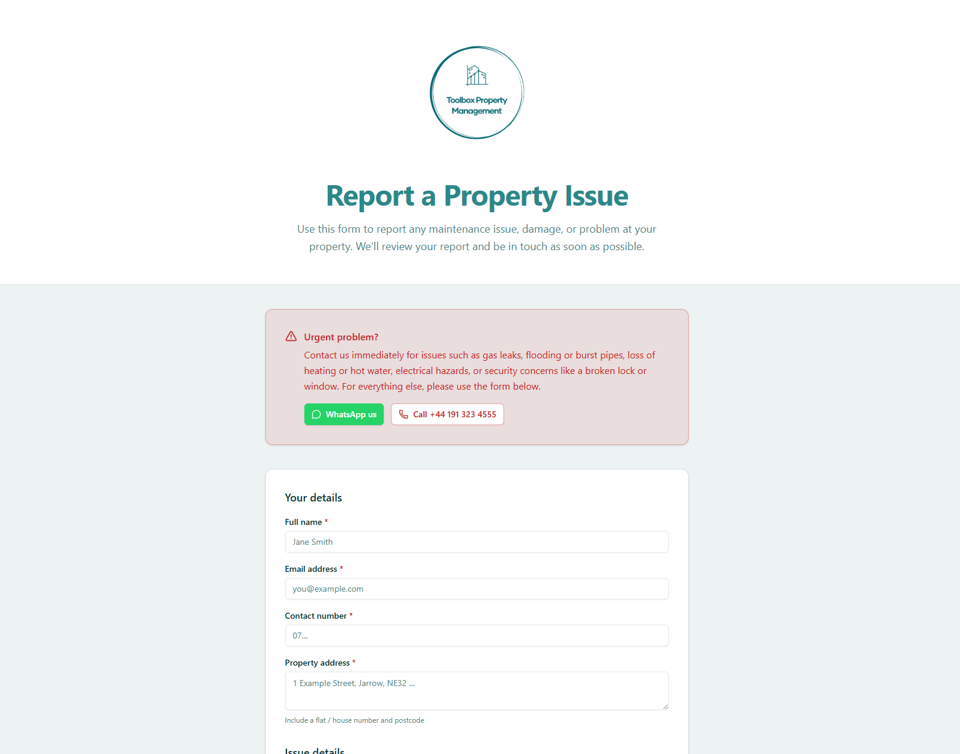
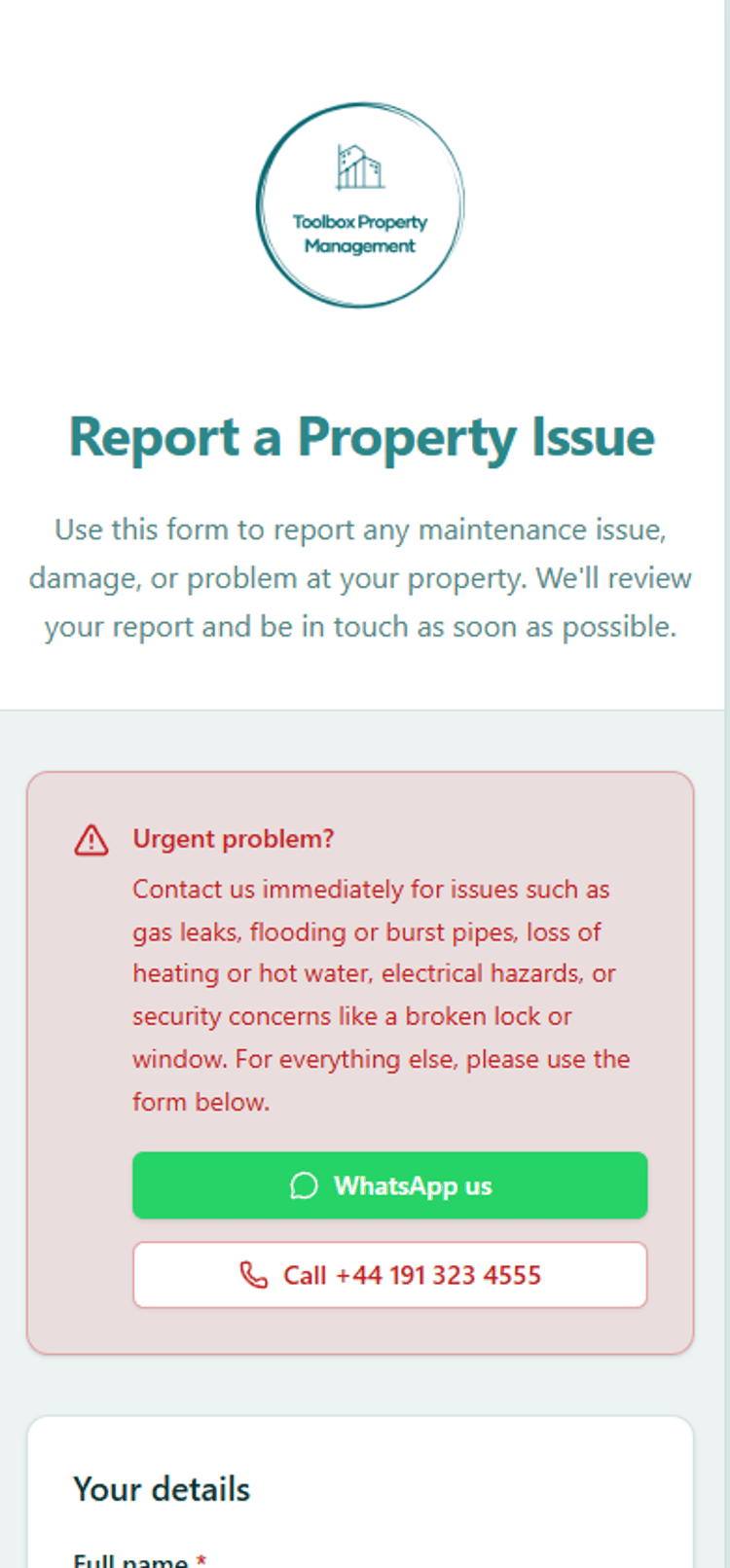
The tenant-facing issue reporter walks through each step in sequence: property address, location within the property, issue type, urgency, access notes, and photo uploads. Each field is validated before the form moves on, so incomplete reports cannot be submitted.
When a tenant submits a report, they get an immediate confirmation on screen and by email. The confirmation includes a unique reference number. That number is the thread that connects every subsequent communication about that issue: the contractor visit, the landlord update, the invoice. Everyone references the same thing.
No report can be lost or misremembered. It exists in the system from the moment the submit button is pressed, timestamped, with every field the team needs to act on it.
The management portal
One place for everything
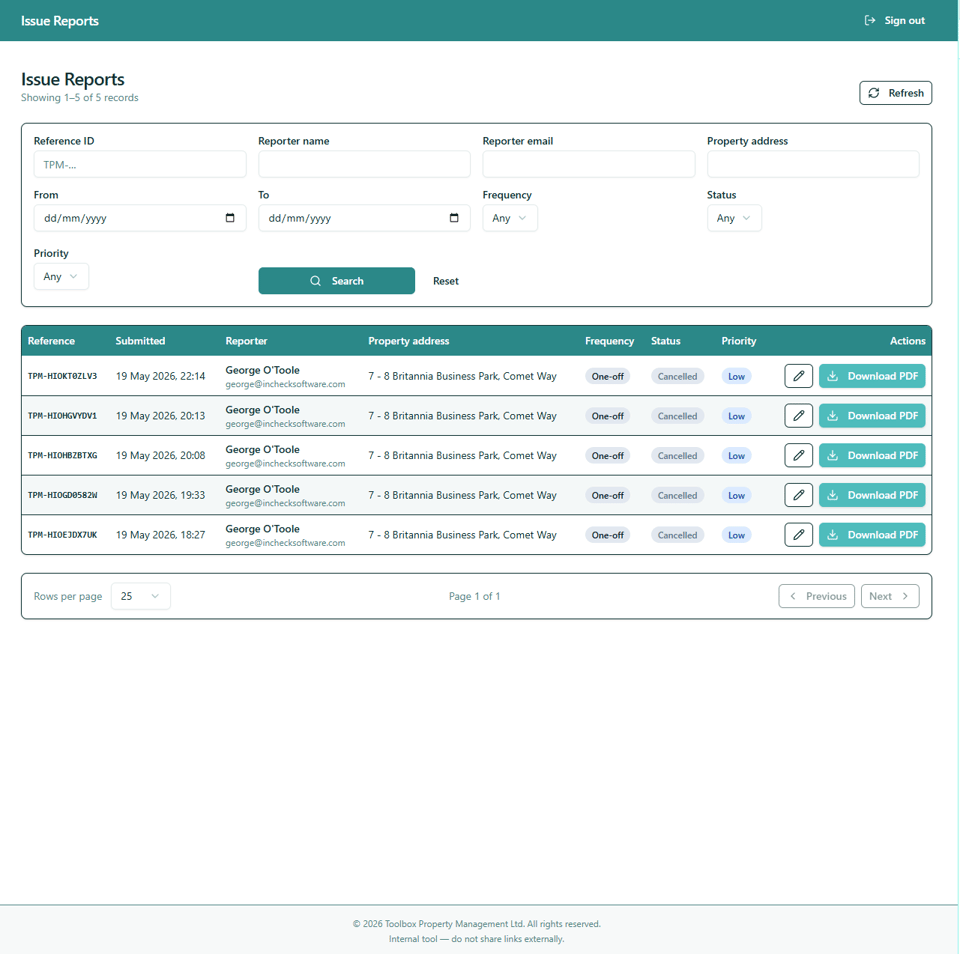
The portal is where the team works. Every submitted issue lands here automatically, with the full detail from the form, the photos, and the reference number. The team can filter by property, by status, by date, or by urgency to work through the queue without switching between inboxes.
Issue status tracking means anyone on the team can see at a glance whether something is waiting for a contractor, waiting for landlord authorisation, or has been resolved. No more “did anyone deal with the boiler at flat 3?” conversations.
The portal is also the place where manual entries are made when something comes in by phone rather than through the form: the record stays consistent regardless of how the report arrived.
Automatic PDF generation
Every issue in the system can produce a formatted PDF report at the click of a button. The PDF includes: the reference number, property details, the full issue description, access notes, submitted photos, and the current status. It is ready to send to a contractor, attach to a landlord update, or file for compliance purposes.
This removes a significant amount of manual work. Before, someone would need to write up a maintenance report by hand and format it for sharing. Now the system produces a professional document automatically, with everything in the right place, every time.
Instant email notifications
When a new issue is submitted, the right people are notified immediately. Tenants get a confirmation. The property management team gets an alert with the headline details. Where relevant, a landlord notification goes out too.
Nobody has to remember to chase. The system sends the emails. The people who need to know, know. The paper trail starts from minute one.
Why this matters if you manage properties
Property management is about accountability: being able to show a landlord exactly what happened, when, and what the outcome was, and being able to do it without hours of admin. A custom platform built around the way your business actually works is far more valuable than a generic property management tool that covers every possible scenario but fits none of them well.
Toolbox now has a contact site that converts enquiries, a reporting flow that produces complete records rather than fragments, and a portal that means the whole team is working from the same picture. The PDFs and email notifications are not features added for the sake of it: they are the parts of the workflow that used to take manual effort and now happen automatically.
If you manage properties and your current process relies on forwarded messages and handwritten logs, this is the kind of system that pays for itself in the first quarter.